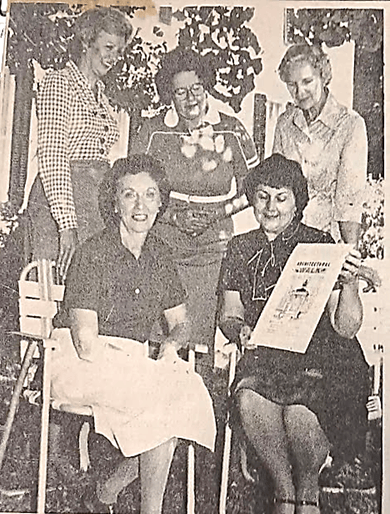
Plans are discussed for the October 2 Architectural Walk, sponsored by the AAUW and the Ashtabula Area Museum and Historical Society by (standing from left) July Pallutch, restoration committee co-chairman; Ruth Payne, museum trustee; Dorothy Bishop, refreshment committee co=chairman (seated from left) and Kathryn Owen, owner of the 1840 Greek Revival home that will be featured on the walk and Junita Erickson, AAUW president, holding the Architectural Walk brochures cover.
An “Architectural Walk” that will benefit both the Ashtabula Area Museum and Historical Society and the Ashtabula Branch of the American Association of University Women is being planned from 1 to 4 p.m. Oct. 2 in Ashtabula Harbor’s historic residential area.
Proceeds will benefit the restoration of Hubbard House by the Museum Society and AAUW local project funding. Tickets are available through members of both groups.
The walk will start at Hubbard House, 1603 Walnut Blvd., where ticket holders will be given a brochure map pointing out architectural features and significant historical facts on each of the nine stopping points. Persons talking the walk may proceed at their own pace; each of the stops will be numbered to correspond with numbers on the brochure map. Hosts and hostesses will be on hand at each stop to provide additional information.
Starting from the Hubbard House, the walk will proceed east to the house where its original owner, an Ohio legislator, was instrumental in having the State of Ohio flag designed by the distinguished architect John Eisenmann. Eisenmann was designer of Cleveland’s famous downtown Arcade as well as numerous buildings at Case Teach.
The walk will continue to Point Park where on the lake side of Walnut Boulevard, is the former U.S. Coast Guard House currently being restored as a Marine Museum. Marine Museum committee members, including Jaycees whose headquarters will be located there as part of the restoration, will be on hand to explain what is being planned for the site. Several pieces of marine artifacts will be on display.
Across the street participants may study the exterior of a Queen Anne Revival home lived in for many years by the captain of the Ashtabula car ferry. Continuing on down the south side of Walnut is the original home of a likeable Irishman who superintended the unloading of the first cargo of iron ore to reach port.
The walk includes a typical colonial shop and well known Kaleva Hall that originally was an Episcopal Church. Harbor High School students will show off the interior of the building as well as commenting on the architectural style. The women of Kaleva will have a display of Finnish artifacts.
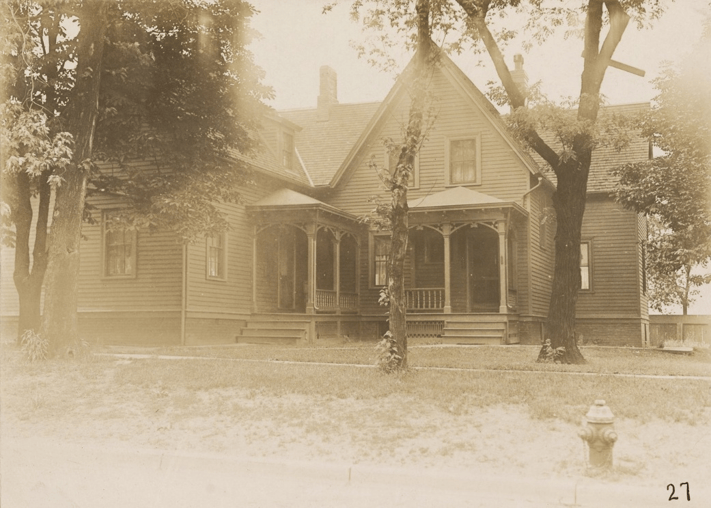
Next on the tour route will be two notable homes; a Greek Revival frarm house that dates back to 1840, and immediately to the east a fine example of Neo-Classic Revival architecture built in 1901.
The walk will end at the Hubbard House where refreshments will be served.
Following the walk, participants are urged to continue with a driving tour west of Ohio Avenue on Walnut Boulevard where their brochure will indicate the addresses of many tasteful and well-designed homes of the late builder-contractor Oscar Brunstead, More than a dozen of the homes he built between 1926 and 1931 are located on Walnut Boulevard.
“We are pleased to join with the Museum group in this joint fund-raising project,” Juanita Erickson, AAUW president said. “As an organization devoted to education, we are well aware of the enrichment program the two museums can provide or students, adults and visitors coming to our city.”
Expressing gratitude to AAUW for their help, Ruth Payne and Josephine Petros, museum project chairmen, agreed that although this first walk is centered in the areas of Ashtabula’s two museums, it is hoped in future years “architecturally interesting tours will be planned for various areas in the county as well as the city.
AAUW committee members include Janis Hall and Jean Sims, coordinators; Marjorie Berkey, Dorothy Bishop, Elaine Cocanoower, Mary Jude English, Sandra R. Humphrey and Cheri Reece.
Museum committee members include Margaret Devney, Virginia Hamm, Judy Pallutch, Mary Scardino, Martha Schlecht, Rosemary Smrdel, Charlotte Wiggins, Payne and Petros.
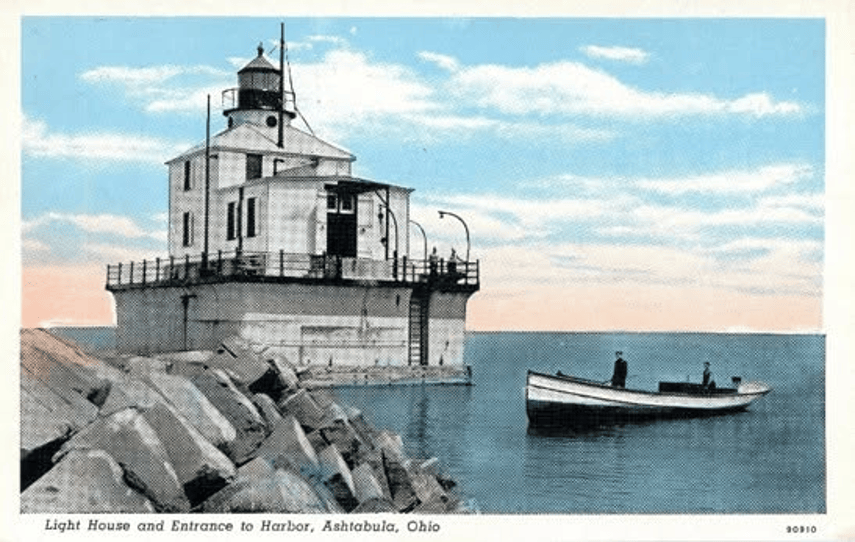
The Ashtabula Maritime and Surface Transportation Museum when it was the lightkeeper’s residence and Lightkeeper John Brophy lived there with his family from 1932-1937. Joe was friends with Jere Brophy, and he recalled Jere with keen and fond memories.
When Joe wrote his memoir, the Lighthouse Keeper’s Son, in 1986, he used terms that pertained to the Harbor area in bygone days. He defined Point Kids as the boys who grew up at or near the eastern end of Walnut Boulevard where Point Park is located. The Bank was the area down over the hill behind the Marine Museum, which area no longer exists, but is covered by huge piles of coal. The Slip is the area of the dock space at the western end of the docks which were accessible in years past, but now also hold piles of coal. His reminiscence appeared in the June 1986 Harbor Journal.
Although Jere was perhaps four years older than we Point Kids of that era, consisting of Paul Heagerty, Johnny Kapsanis, Ray Moser, Lee Nelson and myself, Jere was always willing to have us around him. A W.C. Fields he was not, for he never said, “Get away boys, you bother me.’ He seemed to welcome our being around us and it was a great adventure to be with Jere.
My family and I lived several houses west of the lighthouse keeper’s house. My bedroom was upstairs in the back, overlooking Lake Erie. At night, the light from the lighthouse would flash through my window.
On foggy nights or in rainy weather, the foghorn would wound. I could hear it through my window. Not only the foghorn itself, but also the sound of the engines working the generators that powered the massive foghorn. So, I would hear BEE-COO, BEE COO, pump, pump, pump, pump, pump and so on and so forth. I could see the lights of the freighters as they made their way up and down Lake Erie. It was peaceful and safe. Jere’s dad was on duty, and all was well at the Harbor.
I do not know how Jere put up with us Point Kids. What patience! What understand! Our mothers never questioned us about being with Jere. Whenever my mother would ask where I was or where I was going, if I were going to Jere’s I would respond, “Jere’s.” And all was well.
Jere had a very inventive, creative, intelligent mind. And because he seemed involved in quite a few projects that we shared in, we were able to see at first-hand how a person can get an idea and carry it on to the finish.
One summer, Jere decided to build a rowboat. He drew up his plans, got the lumber and fittings, and built that boat from scratch, not from a kit, right there in the garage. He cut the lumber, planed it down to the right thickness and shape, laid it in place, fastened it down, caulked it, and painted the boat. And, with a set of oars we set out with him on the maiden voyage down over The Bank along the Slip. The boat was perfect from the moment it was placed in the water. Not a leak to be found.
Another time, Jere had the idea that he would like to make a “deep sea diving: outfit. Again, he drew up the plans and set about making it. Of course, we kids were right there at his elbows, “helping” him. He took an old water heater tank and cut it down. He shaped it, put in a water-proof window and the necessary pipes and valves. He padded the part that rested on the shoulders. Then he took his mother’s muffin tins and proceeded to make the lead weights which he bolted on to a heavy, strong leather belt. This was to be used to hold the diver under water.
Then, somehow, Jere took an old tire air pump and fixed it in such a way that air would be pumped out through the hose by both the down and the up-pumping actions. Thus, when the pump was fastened by a long garden hose to the diving helmet, air could be continuously pumped down to the diver under the water.
When the “deep sea diving” outfit was finished, Jere took us down to The Slip where the outfit was tested out on that mysterious sunken ship at The Slip.
Jere was into amateur radio at a noticeably young age. Long before the age of short-wave radio kits, around 1936, Jere decided to make his own “home brew” short-wave radio. And he did! And it worked! Just after dark we would go to Jere’s house up in the attic where Jere had his rig set up and working. I recall it being by a window at the top of the stairs. We could look out the window at Lake Erie. It was something special. He had hung his long antenna, and we could see it stretching out there and then the wire coming in and screwed to his set. Then Jere would begin: “W8QKI W8QKI” W8 Quebec, K-Kentucky, I-Indiana, calling any 50-meter phone. W8QKI on the stern and rockbound coast of Lake Erie calling CQ,CQ, CQ,. Calling CQ. Come in CQ.”
And then we would listen very intently as Jere switched the dials and listened for a fellow ham operator to come in. And then, through the static we would hear, “This is so and so calling W8QKI from and then he would mention where his signal was from. Sometimes the signal would be from down south, the Midwest, near, far. We always hoped for Europe or South America, but who cared. Someone answered Jere’s signal!
There were times when we would go to Jere’s and no one responded to his calls. We were disappointed, but Jere explained it was weather conditions. At times, Jere would change the cell on the set to get greater or closer distance. These various cells wound by hand to certain specifications, were all made by Jere. Wow!
Jere W. Brophy graduated from Harbor High School in the Class of 1937. After graduation, he entered the General Electric Apprenticeship Program. He then entered Ohio State University where he completed four years of study in two and one-half years because he: wanted “to get on with his life.” In 1989, he was the director of planning in Tracor Corporation, covering financial analysis, market planning, strategic planning, business plans and strategies, product plans between divisions, new revenue generations, acquisitions, internal consulting, profit debug, multiple plans and processes, and new product designs for several plants.
Prior to joining Tracor, he owned his own business, Anco, involved in design, consulting in manufacturing of his system, networks, semiconductors, medical problems, strategic planning, problem solving for manufacturing and development engineering, and turnaround situations.
Prior to formatting his own company, he was with Control Data Corporation holding the positions of vice-president of manufacturing and engineering of discs, tapes, controllers, displays, printed circuit boards, power supplies, at all multiple locations in the United States and abroad. He was also responsible for acquisitions and divestures, joint ventures, strategic alliances, and operations involved with manufacturing plants on two sides of the border.
In addition to being heavily involved with the startup and expansion of the computer industries and many others, perhaps his most notable inventions which have directly impacted on the lives of thousands of person around the world are the machine that keeps the human heart pumping when it is out of the body and the machine that cleans the blood for leukemia patients After perfecting these machines, he gave the patents and rights in the associations in the respective fields.
Quite a number of months following the appearance of this article in The Harbor Journal, I was talking with the publisher Chuck Altonen and was told that he had received a request for a number of copies of the article from a person in North Carolina who was Jere’s son who had learned about the article and wanted to circulate it among the family members. I asked for the person’s name and address and phone number.
I had not been in touch Jere since 1937 when he graduated from Harbor High School so I was anxious for any lead regarding his whereabouts I called the number and said to the person on the other end of the line that I wanted to find out how I could get in touch with Jere Brophy. The voice on the other end of the line said, “I’m Jere Brophy!”
I was surprised to hear him and told him sol He said he was visiting his son and just picked up the phone when it rang ‘what luck!
We talked for quite a while trying to get caught up on our lives and I was, to say the least, impressed with Jere’s interesting career. But why should I be so impressed? I knew back when I was a kid that he would do great things in his lifetime, and he has.
During the summer of 1986, I became interested in the harbor and concerned regarding what was or rather was not happening there. In September of 1986. I proposed to a number of my friends that we meet and talk about the Harbor’s situation. We did.
The next month, October 1986, The Harbor Coalition was formed with the primary objective being “helping the Harbor Help itself.” One of the many projects is the sponsoring of the Memorial Day Observance at the Harbor War Memorial on the Harbor High School Campus starting in 1986.
As part of the observance, we selected a Harbor High School graduate who has made exceptional contributions to society since graduation, designating the person the Honored Harbor High School Graduate.
We do this to try to help the community realize the great loss of not just lives, but of people, loved ones, friends. boys with a human potential for good immeasurable at the time they were taken from us. In 1988, Judge Joseph E. Mahoney, of the Court of Common Pleas, who graduated from the class of 1941, was honored.
In 1989, Jere E. Brophy was selected as the Honored Harbor High School Graduate. He attended the Memorial Day Observance, gave a fine speech, and was reunited with many of his classmates from the Class of 1937. The following day, he met with students of Harbor High School’s chemistry, physics, and algebra two classes to speak with them and help them learn about the many opportunities awaiting them.
This whole experience has been most rewarding for the Harbor community. Jere Brophy, and me. I will be forever grateful for having been with Jere again after so many years for, in his mild manner, patient attitude, way back in the 1930s, he made an impression that lasted throughout my life, and I am certain, helped me set my sights and hold firm to the various course I have taken with my life.
Again, Jere, thanks for being you and being there when Paul, Johnny, Ray, Lee, and I grew up around you.
A cat named Jenny really did live on the Titanic. One version of her story goes that she left the ship at Southhampton because she sensed a Catastrophe coming. Another version has her remaining with the ship.