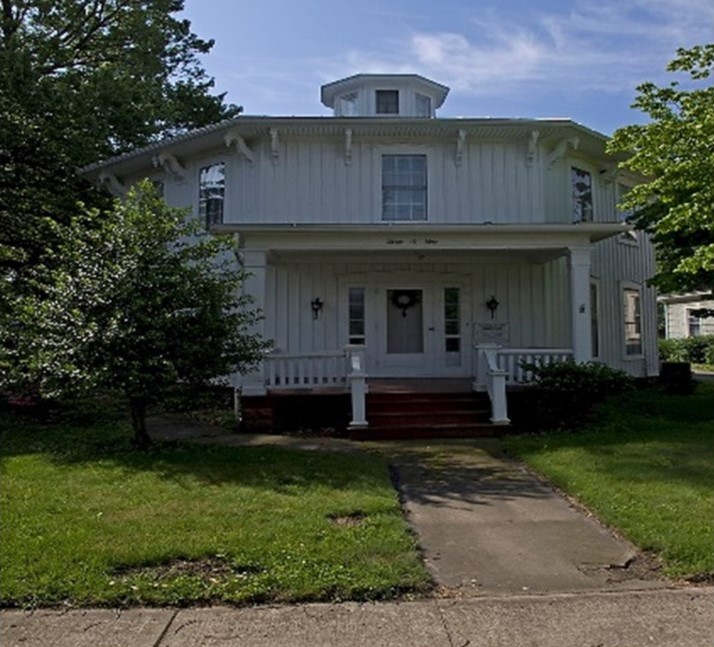
Welcome to Octagon Ohio History, brought to you from the David Cummins Octagon House in Conneaut, Ohio. Ashtabula County and all of Ohio has a fun and fascinating history, so let’s explore it together. Our view from the cupola gives us a bird’s eye view of the state and we can peek into all aspects of its history. Come along for an exciting history adventure!
Edna Mary Wheeler and Geneva-on-the-Lake
“They have made her grave too cold and damp, For a soul so warm and true, She has gone to the Lake of the Dismal Swamp, Where all night long by a firefly lamp, She paddles her white-canoe.”
Although she was just seventeen, Edna Mary Wheeler of Geneva, Ohio, situated along the shore of Lake Erie, opened a window into the lives of nineteenth century women who molded themselves into their world, yet managed to keep their own identifies and contribute to their society.
Edna paddled her white canoe in her soul and in her daily life through her writing, her church, her family and friends. Were Edna Mary Wheeler’s roughly 6, 205 length of days or 17 years long enough to determine whether her writing talent and education could overcome the expectations for 19th Century women who were not expected to paddle their own canoes of any color?
Perhaps her journal that she named Miss J., can answer the questions. Besides writing in her journal, Edna wrote essays and poetry, despite her doubts about her ability to write. On Saturday, November 6, 1875, Edna informed Miss J about a school happening. “Yesterday I read my essay, a book review of A Year at Riverside Farm. It was decided to be the best essay of the afternoon and had twenty-three votes. Quite a majority, but I don’t feel much complimented for all the best writers are on for the last day.”
Despite her doubts, Edna continued to write in Miss J, and her last entries focus on the maritime life of nearby Geneva-on-the-lake and how it shaped the region. Despite her doubts, Edna continued to write in her journal, Miss J., and in her classes at Geneva Normal School.
In Edna’s world, women were expected to be at least minimally educated, marry, and raise children while their husbands worked to support the family. If they dared remain single, the work they were able to get outside their home usually included waitressing, cooking, nursing, or teaching. In many ways, women were treated as second class citizens. They could not own property, enjoy control over their own bodies and lives, or vote. Would Edna fit into those expectations? In another entry in Miss J., she said that she hoped to escape doing housework to make a living.
Although she would not have known the word “teenager,” because her world starkly divided adults and children with no in between, Edna Mary Wheeler of Geneva, Ohio, was a typical 1870s teenager. She went places with her friends, participated in Geneva Normal School activities where she was a top student in her class, and she enjoyed her family. Like many modern teenagers, Edna kept a journal which gives 21st Century readers glimpses of her world and highlights human emotions and experiences that bridge centuries of time. Edna ‘s journal also reveals a developing writing talent and the promise of a future writing life that 19th century viruses and bacteria cut short. Some of these viruses, bacteria, and their descendants survive into the 21st century.
The Wheeler family tree established foundational roots in Stonington, Connecticut, but through the generations branched out into the Western Reserve and Ashtabula County. Census records indicate that her father, Elisha Taylor Wheeler, was a Methodist minister as well as a farmer. Her mother, Mary Cole Wheeler, kept house and cared for Edna and her brothers and sisters.
The 1870 United States Federal Census lists her family this way:
Edna’s parents were Elisha T. Wheeler, age 50, ME Minister; and Mary C. Wheeler, 37. Her sisters were Almira Wheeler, 17 and Olive P. Wheeler, 6, and her brothers were Elmer H. Wheeler,3, and Winifred Wheeler, less than a year old. Edna’s two younger sisters were yet to be born: Ethel on June 30, 1872, in Geneva and her sister Agnes arriving on July 13, 1876. Edna herself was born on October 9, 1860.
Edna described her family in this journal entry before her sister Agnes was born: “Myra is eight years older than I am and Olive is three years younger. Then there is Elmer, Winnie and Ethel, each three years younger than the other, Elmer being three years younger than Olive, the rest following…”
As the daughter of a Methodist minister and a member of 19th century society, Edna absorbed the social and religious values almost with her first breath. She also quickly learned to appreciate the proximity to developing Lake Erie and its attractions as well as her own development.
In her conversation with Miss J. on Friday, August 17, 1877, Edna reports that “a good deal has happened to come to me.” She said that Monday afternoon Will Findley hired and horse and carriage and took her and Mary to the lake and the ride down was splendid. “I felt extremely ‘nice.’”
They visited Mrs. Goodrich’s folks and as soon as Edna went into the house, she put on her bathing suit and went out to the lake. The other girls were already there when she got there, and they had a splendid time. Will and Mary went home that afternoon, but Edna stayed overnight. She took her journal down to the beach, but she did not write in it.
On Tuesday Edna’s family came, along with Miss North. She continued her story.” In the afternoon we started to walk to Sturgeon’s point as the Negro picnic was held there that day.” When Edna and her friends were about halfway to Sturgeon Point, it started to rain, but they kept walking until the rain felt like needles and they hurriedly found shelter in a barn. They waited there until the rain cleared and then Nena, Ida, and Edna took off their shoes and stockings and walked home on the beach. Sara, Edith, and Miss North continued walking to Sturgeon Point, although Edna noted that Sara went only a little way and then came back.
The history of Sturgeon Point that Edna and her friends and family enjoyed goes back sixty years before her birth.
Shoreline Industries, Cullen Spencer, Edwin Pratt, and Sturgeon
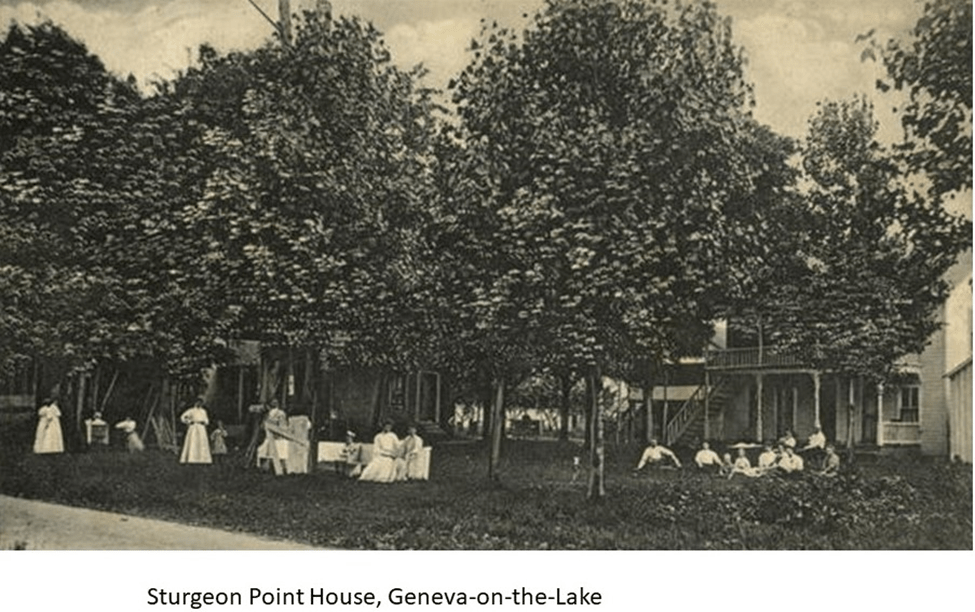
After Moses Cleaveland and his surveying party mapped the Western Reserve, by the early 1800s, industries sprang up on Lake Erie’s shoreline between Cowles Creek and Indian Creek in Geneva on the Lake. These industries included lumber mills, ships works, and limestone ovens. To accommodate tradesmen, travelers, and Lake Erie admirers, the Spencer family opened “Sturgeon Point House” on the Lakeshore. For fifty years Sturgeon Point House backdropped Lake Erie views and provided shelter for Lake Erie visitors. Geneva-on-the-Lake grew along with Edna Wheeler, and she witnessed many of the “dismal swamps” being replaced by rich farmland and sandy beaches.
Inn July 1869, when Edna was nine years old, Cullen Spencer and his friend, Edwin Pratt, developed a public picnic ground on a point of land jutting into Lake Erie that locals had named Sturgeon Point after the lake sturgeon who cruised the cool depths of Lake Erie just off the point. Cool breezes, sandy beaches, and enormous shade trees created an ideal summer retreat for Cleveland vacationers and local families and the Sturgeon Point House was just one of many places for vacationers to stay. Today, Sturgeon Point is known as Mapleton Beach, and still juts out into Lake Erie the same as it did in 1869, but the lake has claimed the original picnic grounds that Edna and her friends enjoyed.
As their picnic ground grew increasingly more popular, Cullen Spencer and Edwin Pratt added a horse powered carousel and other features to their site. Soon the picnic grounds expanded into campgrounds and eventually wooden cottages as more people chose to spend summer vacations enjoying the cooling breezes of Lake Erie instead of the smokey, hot cities of the humming industrial revolutionized Midwest. Soon Geneva-on-the-Lake became a popular vacation resort and equally popular with fishermen determined to catch lake sturgeon and other species that challenged them from Lake Erie.
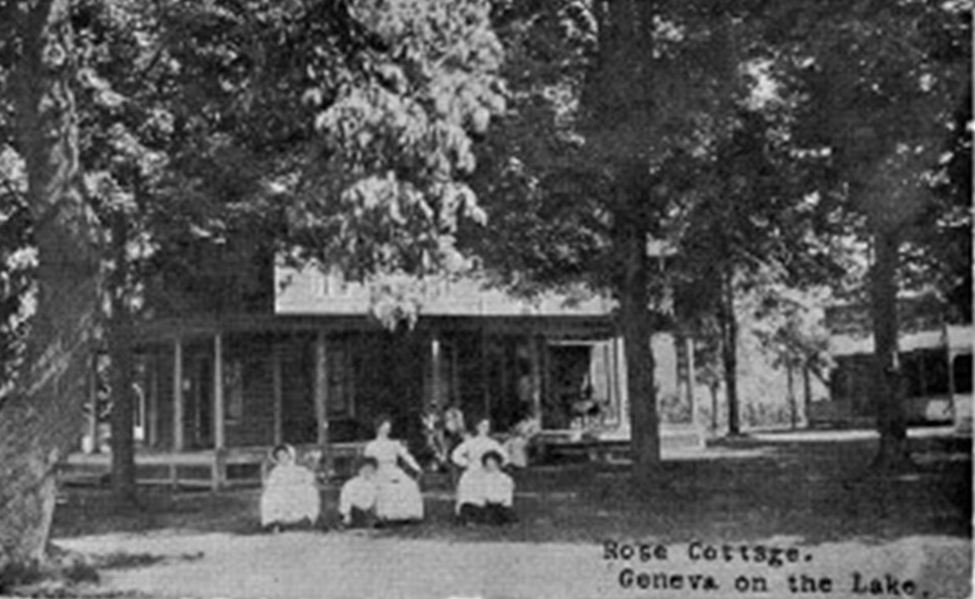
Through more growing years, L.C. Spencer built the regions first dance hall and W.E. Spencer opened Geneva-on-the – Lake’s first tourist home. He christened his tourist home “The Rose Cottage,” to recognize the fragrant wild roses that flourished on the hills around the resort.
Edna’s last entry in Miss J. is dated Geneva, Saturday, August 25, 1877. She noted that Cousin Hannah and Cousin Viola went home after their visit. The day before her father had taken Hannah, Viola, her mother and baby Agnes to the lake. She wrote, “I stayed at home from school yesterday afternoon.”
Perhaps Edna stayed home from school because she already felt sick from diphtheria, scarlet fever or whatever illness she suffered for the next three weeks. She died on September 13, 1877, at 17 years, a little less than a month shy of her 18teenth birthday. Lines from one of her poems are a fitting epitaph.
“His hands are filled with length of days, Wisdom and riches rare. We calleth thee to pleasant ways, to heavenly Mansion’s fair. – “Edna Mary Wheeler –1877

Edna Mary Wheeler is buried in Evergreen Cemetery in Geneva, along with her mother, her brother Elmer, and her sisters Olive and Ethel.
Reading Edna’s journal, Miss J., reveals that despite times of doubt and despair, she paddled her own white canoe through the pages of her journal and throughout a life that ended far too soon.
Captains of Industry Campers John D. Rockefeller, Harvey Firestone, and Henry Ford
Geneva-on-the-lake has survived and has flourished since Edna Wheeler enjoyed its attractions. More than a decade after her death, three titans of the Industrial Revolution chose Geneva-on-the-lake for a yearly expedition to Lake Erie. Interested observers saw servants hurrying to build campfires, pitch tents, and completing the other necessary tasks at their Indian Creek campground to ensure that John D. Rockefeller, Harvey Firestone, and Henry Ford could comfortably camp, fish, and have fun in Geneva-on-the-Lake.
The invention, implementation, and influence of the Henry Ford’s affordable automobile and Harvey Firestone and John D. Rockefeller and their development and marketing of related industries like rubber for tires, gasoline, and other automobile centered products helped all classes of Americans take to the road. Many Northeastern Ohio people took the roads that led to Geneva-on-the-Lake.
The yearly trips that Henry Ford, John D. Rockefeller, and Harvey Firestone took to the Geneva-on-the-Lake resort encouraged their enthusiastic followers to explore the resort. Their respective contributions to the automobile industry that gave millions of people the freedom of wheels played a vital part in growing the fame and fortune of Geneva-on-the-Lake. Edna certainly would have recorded the famous campers and the progress of the resort in Miss J and enjoyed it with her husband and children.
Geneva-on-the-Lake Lures Them In
By 1905, when Edna would likely have been a grandmother, Geneva-on-the-Lake featured over fifty cottages, twenty and more boarding houses, and a reputation for good fishing as well as good fun. Rich and middle-class people from cities like Cleveland, Youngstown, and Pittsburgh sent their families to the resort and the local people frequented it as well. People enjoyed the health and relaxation benefits of cool lake breezes and sandy beaches and the fabulous fun of the place.
For decades, visitors enjoyed daily sightseeing and fishing trips on increasingly technologically modern boats like the “Red Wing.” They played tennis on Ramsey’s “Idle-A-While” clay courts and flocked to the beaches at Chestnut Grove Park to picnic and party and lingered on the lawn of the Colonial Hotel to play whist and bridge. At the New Inn, they enjoyed savory dinners including “milk-fed” chicken and strolled the Shady Beach hillside, admiring the rainbow colors of the sunset over Lake Erie.
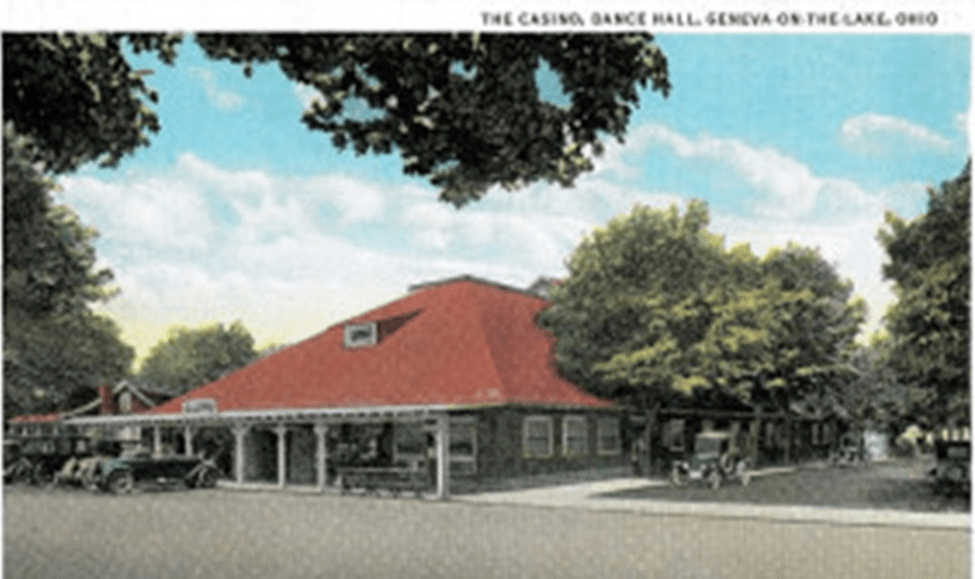
They topped off their fun-filled days with evenings of roller skating, carousel rides, and miniature golf. Or if they preferred dancing, they could go to the Casino, Pergola, or the Pier Dance Hall.
The 1930s and 1940s Boom
In the 1930s and 1940s, when Edna would have been in her 70s and 80s and her younger sister Agnes had survived into her 50s, Geneva-on-the-Lake continued to grow and change with each new decade. By the 1930s, hotels dotted the resort overshadowing the boarding houses and cottages, but not obliterating them.
There were new boat docks, stables for horses, and a modern nine-hole municipal golf course. Geneva-on-the-Lake offered something to people of all ages and classes, just as it had done in Edna’s time. And thanks to Henry Ford, Harvey Firestone, and John D. Rockefeller by the 1940s, people parked their Fords, Oldsmobile’s and Packard’s, and strolled the mile long strip lined with entertainment and food for the body and soul. The Strip was the ideal place to forget the world-wide Depression and the clouds of war beginning to blanket the world.
People of all ages from Ohio, Pennsylvania, New York and beyond gathered enjoyed sunbathing on Lake Erie beaches during the day and dancing to the music of Glenn Miller, Tommy Dorsey, and Duke Ellington on balmy summer nights.
Most of the famous band leaders of the era, including Jimmy Dorsey, Ozzie and Harriet Nelson, Lawrence Welk, and Cab Calloway played at the Pier Dance Hall at Geneva-on-the-Lake. For a while, it look like Kay Kyser’s gig would become permanent. The story goes that before he became a well-known music maker on the radio, his band mutinied and left him stranded and cashless at the resort. Spent the rest of the season living in the attic of the Shady Beach Hotel, courtesy of Helen and Durwood Bowers, its owners and operators.
After Pearl Harbor propelled the United States into World War I, the citizens of Geneva-on-the-Lake offered patriotic hospitality to soldiers, sailors, and Coast Guardsmen. They overcame obstacles like food rationing to the American soldiers who soon would be landing on far away beaches under enemy fire. Gasoline rationing limited long road trips during the World War II years but increasing numbers of families managed to visit Geneva-on-the-Lake. Record numbers of residents and visitors celebrated Victory in Japan day with noisemakers and pot banging.
Young veterans and their wives with their Baby Boomer children considered Geneva-on-the-Lake their favorite playground, and “Pop” Pera and his wife Martha reinforced their opinions. In 1946, entrepreneur “Pop” and his Martha who had purchased the New Inn from the Swan family in 1921, added a new attraction just behind the inn. The Flying Scooters, air bound and the first in the area, instantly attracted people of all ages and provided a panoramic view of Lake Erie and the Strip. Realizing he had a good thing going for them, Pop and Martha added Dodge’ems, kiddie cars, and one by one, developed an 18-ride Erieview Amusement Park.
The 1950s and 1960s Golden, Growing Age
During the 1950s and 1960s, Edna’s grandchildren would have steered the Dodge’em and kiddie cars, shared hot dogs and donuts, and impatiently waited for their mother open the family picnic basket in the Township Park. On Saturday evenings they would have lined up on the Strip to watch the Duck, an amphibious World War II vehicle, escort the beauties who were competing for the title of Miss Geneva-on-the-Lake.
Every July 4, families clustered on blankets on the beaches to watch the fireworks launched from the Duck create rainbows and color storms across the Lake Erie night sky. New attractions appeared with the frequency of Lake Erie waves. New summer homes dotted Chestnut Grove Park and a not far from Indian Creek where the three titans of industry had camped on Indian Creek, Ed and Dottie Andrus created a large and modern campground from the surrounding woods which became the summer home of campers by the thousands.
Every age group found fun at Geneva-on-the-Lake. Toddlers rode the land cars by themselves, while their older brothers and sisters flew through the air on the Scooters, which by then had the modern name of “the Flying Jets.”
Teenagers enjoyed socializing and sodas at Pete’s Grill and twisted with Chubby Checker and slow danced to Elvis Presley’s “Loving You”.
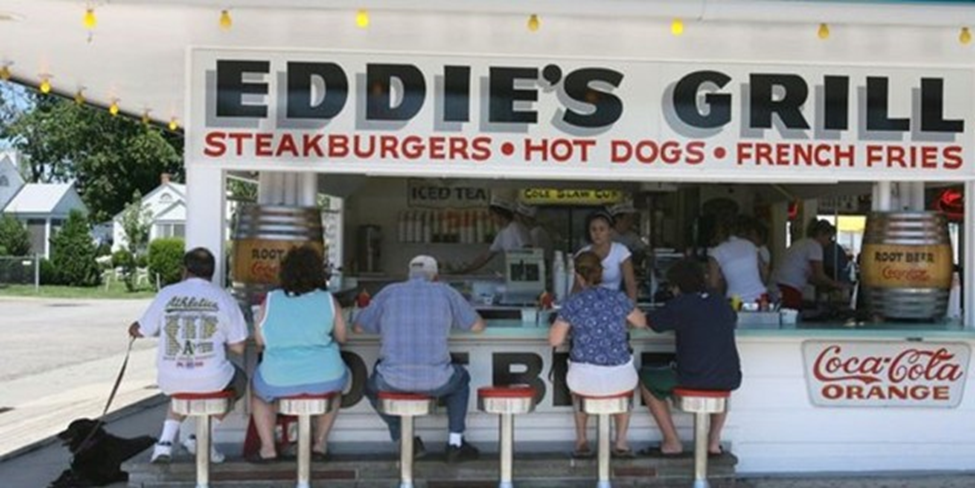
College students who were off work or on break from their jobs waiting tables at the restaurants or operating the amusement park rides, cruised the Strip beating time to the rock music pouring from the organ in The Barn. Adults gathered at the Swallows and the Cocktail Lounge for adult dining and socializing.
Shopping, Games, and Sport Fishing
Geneva-on-the-Lake shops offered plunder for every pocketbook. Edna would have been amazed at the choices! Shoppers could purchase Jantzen bathing suits, souvenirs featuring Lake Erie, clothing, toys, trinkets, and treasures. Arcades and midways offered the challenges of ski and pin ball, and tested shooting skills. Claw machines offered off color playing cards to parent dodging young people.
Charter boat captains steered their boatloads of sport fishermen to the sturgeon and other Lake Erie finny offers. Speed and sail boaters cruised the lake and beach goers swam with or without inner tubes.
Surviving into the 21st Century
The next two decades saw the advertising lure of the theme park, fantasy rides, adventures under the sea and in outer space, and animals as new best friends. Geneva-on-the-Lake remained a modestly price family attraction, with fewer families. But as the years of the 1970s and 1980s chugged on like one of Henry Ford’s Model T cars, more people returned to rediscover the pleasures to themselves and their pocketbooks that Geneva-on-the -Lake had saved for them.
After suffering its own ups and downs through the years, state, local, and national governments and private industries cooperated to resurrect Lake Erie from decay and death. People and businesses joined the resurrection of Lake Erie and Geneva-on-the-Lake. Owners renovate old houses and cottages. Entrepreneurs built condominiums. Hotels and motels remodeled and expanded, and bed and breakfasts lured guests with home baking and canopied beds.
In the mid-1980s, the state of Ohio stepped onto the renovation bandwagon by creating new bathing facilities, and camping and hiking innovations in Geneva State Park, just west of the Strip. By the early 1990s, the state had added a 385-slip marina and a small boat harbor with six public boat ramps, all open to the public. Bathers, both sun and swimming style, enjoy the spacious State Park beach.
Golfers enjoy the greens on the 18-hole public golf course, and shoppers enjoy the 21st century selections in the stores and restaurants, and backdrop music of the 21st century.
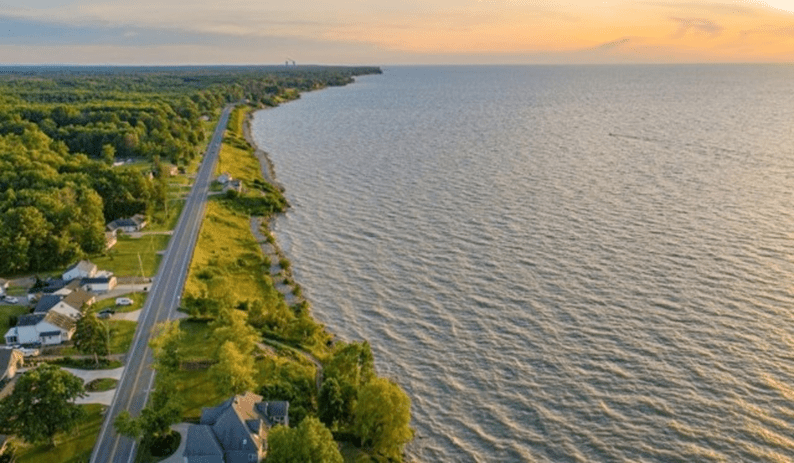
Edna lived and died in the eighteenth century, and she would be astonished at the changes in her favorite picnic ground. Her children and grandchildren would probably be surprised too, and perhaps her great grandchildren would raise an eyebrow or two at contemporary Geneva-on-the-Lake. But adventurous Edna wheeler would comfortably paddle her white canoe over changing but ageless Lake Erie, land on the beach she knew, and step out of it ready to explore 21st century Geneva-on-the-Lake with eagerness and excitement.
 Onward Octagon Ohio History: Cupola Chronicles