
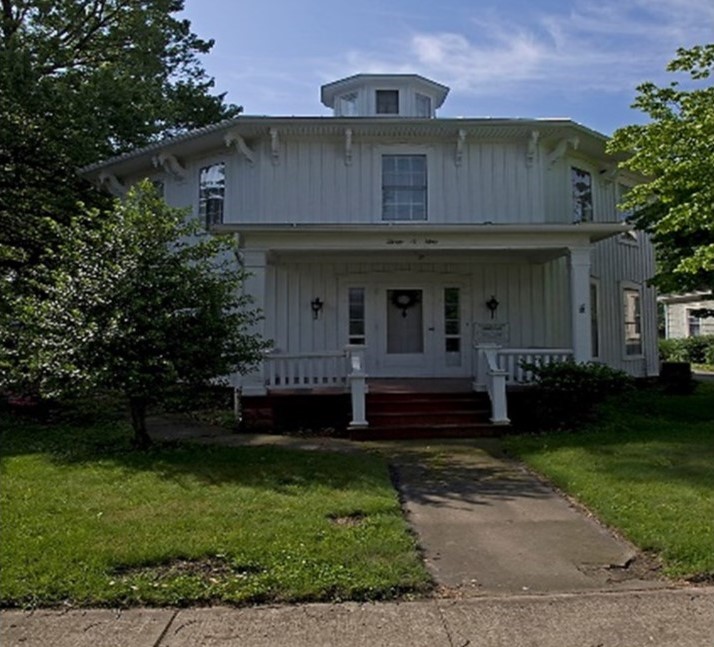
Welcome to Cupola Chronicles, brought to you from the David Cummins Octagon House in Conneaut, Ohio. Ashtabula County and all of Ohio has a fascinating and fun history so let’s explore it together! Our view from the cupola gives us a bird’s eye view of our state and we can peek into all aspects of its history. Come along for an exciting history adventure!
Elizabeth Stiles, President Abraham Lincoln’s Spy

Elizabeth Stiles opened her eyes to the world in East Ashtabula, Ohio. Her life years between August 21, 1816, and February 14, 1898, took her to Illinois, Kansas and her spying missions for President Abraham Lincoln expanded her travels to other states.
She spent the later years of her life with her adopted son and daughter in Fertigs, Pennsylvania and closed her eyes for the last time at the Woman’s Relief Corps home in Madison, Ohio, about ten miles from her birthplace in East Ashtabula.
Throughout her life, Elizabeth faced difficulties, danger, and heartbreak with a steadfast gaze and quick intelligence that enabled her to survive her husband’s murder, spying for the Union, and capture by a Confederate general.
Ashtabula and Elizabeth Stiles
When Elizabeth greeted the world on August 21, 1816, her mother Clarissa, and father John Fox Brown, and her brother John Jones Brown were new settlers in East Ashtabula, situated on the east bank of the Ashtabula River.

Elizabeth’s father, John Fox Brown and her mother Clarissa Chamberlain Brown hailed from Middleton, Connecticut, and her brother, John Jones Brown, was born in Middletown, Connecticut in 1813.
Elizabeth was born in Ashtabula in 1816, and her younger sister Emeline in 1828, also in Ashtabula. Ashtabula and Elizabeth Stiles grew up together. East and West Ashtabula on both sides of the Ashtabula River and the few houses at the harbor where the river flowed into Lake Erie made up early Ashtabula.
The rivalry between East and West Ashtabula began almost as soon as the first settlers climbed wearily down from their wagons or beached their boats on the Ashtabula Riverbank.
Thick stands of oak, maple, and hemlock trees canopied the fertile soil and snow buried the trees under a white blanket in winter. The early settles quickly set to work cutting down the trees for wood to build their houses, barns, and businesses. Soon, log houses punctuated the forests like the quilt squares the pioneer women piecedand gardens and fields of corn and other crops provided quilted backing for the landscape.
Many people could not see the smoke rising from their neighbor’s chimneys above the trees, because their log houses were so far apart with frame barns behind just a few of them. Roads not much wider than a horse and wagon snaked around the trees. Both trails and roads led to the taverns located in all three of the settlements.

Gideon Leet kept a log tavern in East Ashtabula about a mile from Lake Erie and settlers built a log schoolhouse on Bunker Hill, hiring Miss Lucy Badger to be the first teacher. The Browns eventually settled on a farm on Bunker Hill in East Ashtabula. An 1874 Atlas noted that John F. Brown owned fifty-seven ½ acres of land mostly north of the New York Central right of way, with a small portion located south of Columbus Avenue.
Elizabeth’s Family Ties
John Fox and Clarissa Chamberlain Brown were natives of Middletown, Connecticut where they were married on April 17, 1811. During their 17-year marriage, they had eight children. Their sons Justin and John Jones were born while they still lived in Middletown, while Samuel C.; Elizabeth W; William L.; Clarissa; Emmaline; and George W. were born in Ashtabula. Elizabeth’s mother Clarissa died on February 14, 1829, when she was 36 years old and she is buried in Edgewood Cemetery, Ashtabula.
According to the U.S. Federal Census, John Fox “Corker” Brown, a caulker by trade, lived in Ashtabula in 1850; he lived in Barton, New York, in 1860; during the 1870s and 1880s he again lived in Ashtabula, and on October 12, 1883, he died in Broken Bow, Nebraska. He is buried in Edgewood Cemetery, Ashtabula. During his years in Ashtabula County, John Fox Brown was actively involved in the community. In 1853 he served as a member of the Ashtabula Village Council and in 1854, he was one of the charter members of Rock Creek Lodge No. 254 of the International Order of Odd Fellows.
An expert rifleman, John F. Brown introduced his daughter Elizabeth to guns when she was just five years old, teaching her how to shoot and maintain them. She became an expert shot, and they shared many hunting trips. She spent her childhood exploring the woods around Ashtabula and hunting with her father. Her obituary in the Goshen Daily Democrat described her childhood this way,
“She was the master spirit of the home and neighborhood. At the age of five years she could handle a gun and ride on horseback, in which accomplishments she became proficient. In her teens she had a far-reaching and enviable reputation as an expert cheesemaker and skillful nurse.”
Elizabeth’s mother, a talented nurse, often took Elizabeth with her on patient calls attending births, nursing sickness, and helping families deal with deaths, teaching her daughter the nursing skills that she herself had practiced for so many years. Elizabeth received her formal schooling in Ashtabula schools and may even have taught a few terms herself before she left Ashtabula for Chicago when she was 21 years old.
When Elizabeth left Ashtabula bound for Chicago, her hometown had grown from a simple frontier settlement to a rapidly expanding town on both sides of the Ashtabula River, and both east and west settlements were creeping their way to meet the one at the Ashtabula Harbor. Steamboats were stopping at the harbor, and one had already been built there. Sail vessels were traversing the lakes, and railroads had been proposed.
The major roads in the village were Main Street, Prospect, Lake, and Division Streets, and the various roads leading in and out of the village. The North and South squares were laid out and a cemetery was located behind the existingschoolhouses. Stores were scattered along main street in different places, with several between North and South Park and extending toward Bunker Hill. Houses had evolved from logs to frame structures with at least one brick building in their midst. The Ashtabula Academy stood on the corner of Main Street and North Park and William Hubbard taught there.
In 1837 when Elizabeth Brown was 21 years old, she moved to Chicago, supporting herself with her skills as a seamstress, teacher, and nurse. Like most of her contemporaries, she considered family a primary force in her life and her parents, her brother John Jones Brown and her sister Emeline Brown Dolph played important parts in her story. Emeline’s daughter Clara helped Elizabeth in her spying for the Union.
John Jones and Catherine Holtzclaw Brown
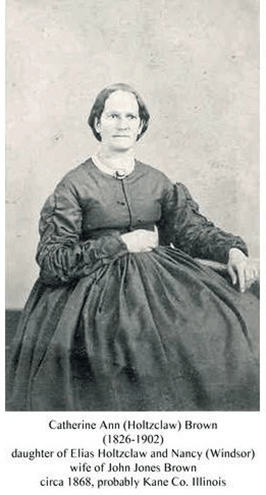
Elizabeth’s brother John Jones Brown had left Ashtabula County in 1835 and moved to Chicago. Shortly after Elizabeth’s arrival in Chicago in 18 7, John moved to Kane County, Illinois, and by 1839 he had saved enough money to buy 120 acres of land in Rutland, Illinois. John returned to Ohio to visit relatives and during his visit he married Catherine Ann Holtzclaw on November 15, 1855.
He farmed, and later acquired milk cows to begin dairy farming. He continued to buy land in Kane County, Illinois and by 1878, he owned four hundred acres of land, valued at $25,000.
While he lived in Kane County, John Jones Brown served as postmaster for six years, Justice of the Peace for seven years, and a School Trustee for nine years.

He retired from farming in 1878, putting up the farm for sale “at the low price of $45 per acre, part cash, the balance to suit purchasers, long time given at 7 per cent interest.”
The couple had five children, two daughters dying in infancy and two sons, Ernest Foster and Lendell Luce Brown, and a daughter, Clara Chamberlain Brown French surviving into adulthood and lives and children of their own.
John Jones and Catherine Brown spent most of their married life in Monmouth and Elgin, Illinois, where they farmed for a living. In 1879, Catherine and John moved to western Kansas in the hopes that their economic fortunes and John’s consumption would improve. They suffered the same privations that other settlers in western Kansas endured, and John Jones Brown died in 1883.
Beginning in 1894, Catherine lived with her daughter Clara and spent alternating summers with her son Lendell. John Jones Brown is buried in Wayne Cemetery, in Lewis Kansas, and Catherine Holtzclaw Brown died in 1902 and she is buried in Oak Park Cemetery in Chandler, Oklahoma.
Emeline Lucy Brown Dolph
In 1828, Emeline Lucy Brown was born in Ashtabula, Ohio, when her sister Elizabeth was twelve years old. The 1850 United States Federal Census lists Emeline Lucy Brown, the 23 years old living in Dorset with the Dolph family. There were two Osman Dolphs, probably father and son. The older Osman Dolph was forty-six and Osman A. Dolph, probably his son, was 19 years old. The elder Osman Dolph and his first wife Ollive Horton Dolph both hailed from New York State but resettled in Ashtabula County. Osman and Ollive had ten children and she died in 1848 and she is buried in West Andover Cemetery in Andover, Ohio. Osman Dolph is buried in West Jefferson Cemetery in West Jefferson, Ohio.
When she was 22 years old, Emeline Lucy Brown married Osman Dolph, age 46, in Ashtabula, Ohio, on October 16, 1850, according to Ashtabula County marriage records and the newlyweds lived in Dorset. Their daughter Clara Elizabeth Dolph was born on March 17, 1852, in Dorset and their son, George Osman Dolph was born on April 5, 1853, in Andover, Ohio. Osman and Emeline Dolph and their two children moved to Kansas City, Missouri, where Emeline died in 1858 when she was 30 years old. She is buried in Edgewood Cemetery, Ashtabula.
Elizabeth Brown Marries Jacob Stiles in Chicago
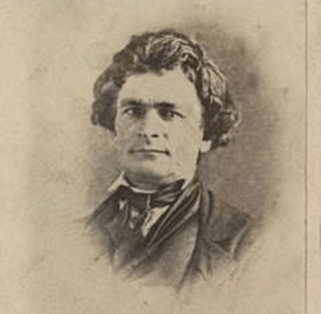
For approximately nine years, Elizabeth Brown worked in Chicago, as a nurse, teacher, seamstress. She married Jacob Stiles, who was born about 1820 in New York, in Chicago in 1846. Some sources state that Jacob came from the prominent Stiles family in Ashtabula, which in turn traced its origins back to the Stiles family of Connecticut.
The 1850 United States Census revealed that Jacob and Elizabeth were living in Peoria with a four-year-old girl named Sarah Stiles. Some sources say that Sarah was adopted while other imply that Sarah was the biological child of Elizabeth and Jacob. Some of the sources about her life say that throughout her long life, Elizabeth adopted many children. It is not clear whether Sarah was the natural child of Elizabeth and Jacob, or Elizabeth and Jacob had adopted her. In 1861, Elizabeth and Jacob did adopt her niece and nephew, Clara Elizabeth and George Osman Dolph, fulfilling a promise she had made to her sister Emeline on her deathbed in 1858.
In 1859, Elizabeth and Jacob moved to Shawneetown, Kansas, possibly for Elizabeth to teach at the Indian Mission or to homestead or both. People from the Western Reserve usually moved to Kansas for economic opportunities, a better climate, or because they were passionately involved in the slavery- anti-slavery politics of their time. Setters coming from Ashtabula County were especially passionate about carrying on the New England tradition of Abolitionism and determined to practice what they preached in their daily lives.
By 1860, the United States Federal Census listed Jacob and Elizabeth Stiles, both 40 years old, as residing in Shawnee, Johnson County, Kansas Territory, with Sarah Anne Stiles 10, Clara Elizabeth Dolph 10, and George Osman Dolph Stiles. Jacob gave his employment as a grocer.
Rehearsal for the Civil War
Elizabeth’s family, John Brown Sr. and Jr., Jim Lane, and William Quantrill played important roles in Elizabeth’s life and spying career along with Abolitionists, the Kansas-Nebraska Act, and Bleeding Kansas. The mists of history obscure how deeply they were involved in her life, but events testify to their involvement at some level.
The Bellevue Republic County Freeman Bellevue, Kansas, March 18, 1898, recorded an incident that happened while she taught school in Shawnee. Elizabeth and a teacher in an adjoining district planned a picnic in the woods to celebrate the Fourth of July. Carrying the Stars and Stripes, the teachers and their scholars marched around the liberty pole in the village green and then they marched to the woods and settled chose their spots for a day of fun and picnicking. They had scarcely settled on their blankets and opened their picnic baskets when a man rode up, handed Elizabeth a note, and galloped away without saying a word.
The note warned her that if she and her pupils marched again at the liberty pole parade with the Union flag, she would be wearing tar and feathers.[3]
The question of whether the United States should be a slave holding or free country had divided the Americans for decades before Elizabeth and Jacob Stiles moved to Kansas. The debates brewed to a boiling point as the United States expanded west and more states were admitted to the Union. Compromises like the Missouri Compromise and the Compromise of 1850 did not settle the issue of balancing the free and slave states or bridge the widening chasm between the North and South.
In 1854, Congress passed the Kansas-Nebraska Act making Kansas a territory and mandating that its citizens would decide whether Kansas would be admitted to the Union as a free or slave state. The passage of the Kansas Nebraska Act ignited a rivalry with proslavery supporters from the bordering state of Missouri, a rivalry that escalated into raids, stealing and killing by Missouri border ruffians and Jayhawker reprisals to the extent that Kansas acquired the name “Bleeding Kansas.”
Missouri remained a Union State throughout the Civil War, but its residents were fiercely partisan, with many committed to the South, states’ rights and slavery, while others believed just as passionately in the Union. Missourians angrily watched Yankees arriving across the state line in Kansas and Federal troops occupying the region and they resisted. Equally partisan Jayhawkers and other citizens in Kansas Territory were determined that citizens of the territory would decide whether it would be free or slave, while Abolitionists vowed to aid runaway slaves and keep slavery out of Kansas.
John Brown Jr. and Wealthy Hotchkiss Brown
Abolitionist John Brown and his sons arrived in Kansas before Jacob and Elizabeth arrived in Shawnee, determined to prevent Kansas from becoming a slave state and liberate as many slaves as they could. John Brown Jr. and his wife Wealthy Hotchkiss Brown shared close ties to Ohio with Elizabeth Stiles and her family. Born on July 25, 1821, in Hudson, Summit County, Ohio, around 1842, John Brown Jr. enrolled in the Grand River Institute in Austinburg, Ohio. In the summer of 1847, he married Wealthy Hotchkiss, who was also born in Ohio in 1829.
In 1855, Wealthy and John Brown Jr. moved to Franklin County, Kansas, and later that year several other family members moved to Kansas. During Wealthy’s time in Kansas, Wealthy’s father-in-law John Brown and her brothers-in-law became involved in fights with proslavery citizens in Lawrence, Blackjack, Osawatomie, and the Pottawatomie Massacre. John Brown Jr. organized a free-state militia in the Kansas Territory and as a captain of the Kansas Cavalry, he was the only child of John Brown to fight in the Civil War.
Although John Brown Jr. had no part in the Pottawatomie Massacre, Federal authorities imprisoned him on charges of treason for much of 1856. Wealthy and John Brown eventually settled in Put-in- Bay, Ohio. They both died there, he in 1895, and she in 1911 and they are buried in Crown Hill Cemetery in Put-in-Bay.
![johnbrownjr]() John Brown Jr., Company K, and the Seventh Kansas Volunteer Cavalry
John Brown Jr., Company K, and the Seventh Kansas Volunteer Cavalry
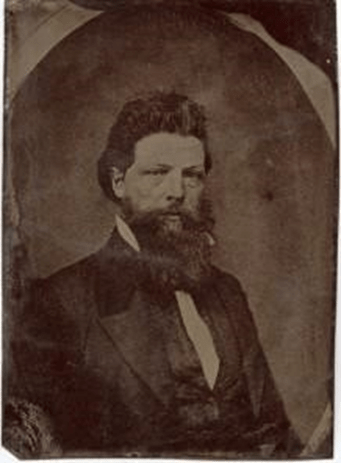
In his History of Ashtabula County, Ohio, William Williams wrote that John Brown, Jr. received the authority to recruit and transport a company of riflemen in Kansas and he recruited them primarily from the hunters of western Pennsylvania, from Ashtabula County, and from northwestern Michigan. On November 12, 1861, they were mustered into the Seventh Kansas Cavalry as Company K., with Colonel Charles R. Jennison as commander. Fighting the bushwhackers in western Missouri along the borders of Kansas and the Indian Territory was the Seventh’s first assignment and as the War wore on, it participated in battles in Mississippi, Alabama, and Tennessee and in many skirmishes until the end of the War when it was mustered out at Fort Leavenworth in 1865.
Simon M. Fox in his Early History of the Seventh Kansas Cavalry, wrote “that the most notable company, however, was from Ashtabula County, Ohio, and was commanded by John Brown, Jr. The members of this company were all fanatical Abolitionists.”
James Henry Lane

A U.S. Congressman from Indiana voting for the Kansas-Nebraska Act, James Lane who was born in Lawrenceburg, Indiana joined the state bar in 1840, practiced law, and commanded the 3rd and 5th Indiana Regiments during the Mexican War. He served as a U.S. Congressman from Indiana from 1853-1855.
Acting on his beliefs, James Lane moved to Kansas Territory in 1855, and quickly became a central figure in Kansas Abolitionism. His supporters named him commander of the Free State Army or Jayhawkers, a leading Free-Soil militant group.
In 1855, he served as the president of the convention that drafted the anti-slavery Topeka Constitution. In 1861, after the Free Soilers successfully agitated to admit Kansas to the Union as a free state, Kansas citizens elected Jim Lane as one of the new states first United States senators and they reelected him in 1865.
By the time Jacob and Elizabeth Stiles and their children arrived in Shawnee, Kansas, the Kansas and Missouri partisans had fought enough battles and staged enough raids on both sides for Kansas to be known as bleeding Kansas and partisans fighting under the names Missouri Bushwackers and Kansas Jayhawkers inspired fear and hatred on both sides.
William Quantrill, a fellow Ohioan from Canal Dover and a one-time schoolteacher and his raiders were one of the guerilla groups operating in the area that would play a significant part in Elizabeth’s life. Both Elizabeth and Jacob were intensely loyal and patriotic Union supporters. Southern sympathizers surround them during their time in Shawnee, but they were fearless and outspoken.
Confederate sympathizers suspected Elizabeth Stiles of partisanship with good reason because she embarked on short mysterious missions for the Union troops. Later she proudly told the story of how she and Jacob and her daughters had captured a cannon from Confederate partisans that several bands of men had unsuccessfully tried to capture. But for the most part, Elizabeth and Jacob tried to keep their lives as normal as possible. Jacob settled down into managing his grocery business, and Elizabeth cared for Sarah Anne Stiles and George and Clara Dolph, and she continued her teaching and nursing in their new Kansas home.
Elizabeth Brown Stiles and Jacob Stiles formally adopted George and Clara Dolph on June 4, 1861, fulfilling a promise they had made to Elizabeth’s sister Emeline on her deathbed.
Quantrill and his Raiders Pillage Shawnee, Twice!
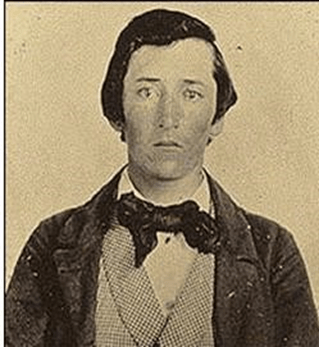
The lives of fellow Ohioans William Quantrill and Jacob and Elizabeth Stiles clashed in Shawnee, Kansas on October 17, 1862.
Born on October 1837, in Canal Dover, Ohio, William Quantrill was the son of a schoolteacher and had taught school himself and worked at various trades in Ohio, Illinois, and Indiana before he moved to Missouri in 1855 when he was 18 years old. In 1858, he traveled to Kansas where he earned his living as a gambler and taught school in Lawrence before he became involved in the border violence and fled to Missouri in 1860.
When the Civil War officially began in April 1861, William Quantrill fought for the Confederacy at the Battles of Wilson’s Creek and Lexington, Missouri. By late 1861, he had collected a band of several hundred men to attack Unionists along the Missouri-Kansas border.
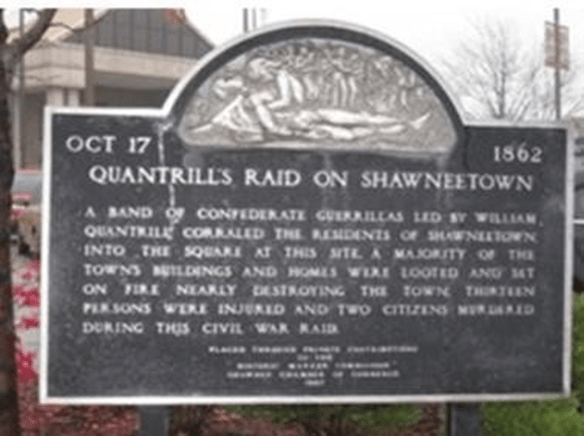
On October 17, 1862, William Quantrill and his gang of approximately 140 bushwhackers stormed into Shawnee and herded the residents into the town square located next to the present-day City Hall. Tradition has it that the bushwhackers staged this first raid because they were short of clothing and horses. After the bushwhackers had collected what they wanted and had killed two Shawnee residents, they set fire to the town and burned all of the buildings in Shawnee- amounting to twenty at that time.
William Quantrill and his raiders raided Shawnee, Kansas, the second time during the summer of 1863, a raid that was a rehearsal for their attack on Lawrence, Kansas which occurred in August 1863.
Jacob Stiles and a Mr. Becker or Baker were the two Shawnee residents that Quantrill and his raiders killed in the first Shawnee raid on October 17, 1862.Some accounts say that a group of raiders appeared in Elizabeth and Jacob’s front yard.
The raiders approached two men, Jacob Stiles and a Mr. Becker or Baker, outside the Stiles home. According to Elizabeth’s reports to newspapers, they asked the men their politics. When they replied “Union,” they were both shot. Other accounts say that the family was inside the house, but the raiders wore blue uniforms and identified themselves as Union soldiers, so Elizabeth opened the door. She stood on the porch and watched horrified as the raiders shot her husband.
![Quantrillsraidonshawneetown]() Quantrill’s Raiders Murder Jacob Stiles, but Spare Elizabeth
Quantrill’s Raiders Murder Jacob Stiles, but Spare Elizabeth
A story in the Oct. 25, 1862, issue of the Olathe Mirror confirms that Jacob and Elizabeth were living in Shawnee during the raid and that Jacob was one of the men killed, though it misspells their last name.
The story said that “Mrs. Styles assures us that Quantrill was at Shawnee and the leader of the murdering gang. She says her husband was shot by George Todd of Kansas City, and that he afterwards told her that her life should be spared if she would go to Kansas City and tell them that he had killed two of their citizens within a week.”
Elizabeth said that after George Todd had shot Jacob, a man named Palmer who was a long-time resident of Shawnee and their neighbor, put the muzzle of his gun to Jacob’s mouth and shot him again. According to her adopted daughter Clara, William Quantrill and his raiders recognized Elizabeth as a nurse and had heard the rumors that she was passing information to Union commanders. They backed her into her little kitchen and William Quantrill looked her up and down with his cold blue eyes while his men urged him to shoot her. Elizabeth stared back without flinching. Quantrill snapped his fingers and commanded, “Let her go boys. She’s too pretty to shoot ”
Next, the raiders ambushed a small band of Union soldiers on patrol duty, immediately hanging six of them and shooting the seventh. The raiders bragged that they would return and do the same to Elizabeth Stiles. After Jacob’s murder, Confederate sympathizers threatened Elizabeth and her three children and Confederate sympathizers let it be known that they had placed a $1,000 price on her head.
Army officers at Fort Leavenworth were so concerned for her safety that they sent a detachment of soldiers to bring Elizabeth and her three children to the fort for protection. Elizabeth and her children left her home that she had spent years tending and where she had spent many contented hours with her husband and children. A detachment of Union scouts under the command of Lieutenant George H. Hoyt escorted them to Fort Leavenworth.
Elizabeth Stiles did not have the anguished comfort of burying Jacobs body. His Find a Grave record says that he was murdered, and his body was lost or destroyed or left by the side of the road. Partisans on both sides of the slavery question hated each other so intensely that it would not be out of character for Quantrill and his men to destroy Jacob’s body. A story in the Goshen Daily Democrat states that somehow Elizabeth got word to the Federal troops about her husband’s death and they came and collected his body and buried him.
Shortly after Elizabeth and her children arrived at Fort Leavenworth, she received a letter from James Lane informing her that President Lincoln had important work for her to do. The fact that Jim Lane wrote her a letter indicates that she was a well-known person in Shawnee and her reaction to the letter proves that she was a determined and courageous woman who lived by her principles. Her family tradition says that after Jacob’s murder Elizabeth was determined to avenge his death and carry on his legacy of Union ideals, so she agreed to be a spy for the Union.
Elizabeth Signs the Oath of Allegiance and Spies for the Union
Elizabeth had previously embarked on several spying expeditions for the Union and the Union Army leaders had learned that she was a trusty ally and sent her name to headquarters. She and her children had been at Fort Leavenworth for just a few weeks when General Jim Lane sent her a letter, also signed by Abraham Lincoln, asking her to come to Washington D.C.
Senator A.C. Marvin of Missouri and about seventy-five other people were preparing to travel to the Capital and Elizabeth went with them. When Elizabeth presented herself to Senator Lane, he informed her that her country desired her services as a spy, and she eagerly accepted. Before she began her spying duties, she returned to Fort Leavenworth for her children and took them back to Washington, D.C., a tedious journey that took several months. She placed Sarah and George in school in Washington and taking Clara as a companion, she began her spying for the Union.

The National Archives has a copy of the Oath of Allegiance that Elizabeth signed. It read: “I will serve them honestly and faithfully against all their enemies or opposers whatsoever and observe and obey the orders of the President of the United States and the orders of the officers under whom I may be employed.”
Elizabeth posed as an old, pipe-smoking Southern woman and nurse, and Clara played her granddaughter. They moved throughout the South, pretending they were looking for Clara’s father, a Confederate soldier.


A picture of Elizabeth in her old Southern woman costume can be found in her photo album that is now owned by the genealogical society in Ashtabula County where she lived after her spying days were over. She also posed as a Southern military nurse while she gathered information for the Union.…”.
After she enrolled her daughter Sarah and son George in school in Washington D.C., Elizabeth and her thirteen-year-old daughter Clara began their spying careers. Newspaper stories detailing her spying methods reveal that she often hid secret messages in her bonnet. One of Elizabeth’s early spying adventures with her adopted daughter Clara involved a long ride on a dark night along the Missouri-Kansas border. Clara fell asleep on her horse which she often did, and she did not wake up even when a sentry grasped the bridle of Elizabeth’s horse in an attempt to arrest her. Clara did not wake up until she heard a pistol shot. Soon her mother rode up beside her, but there was a vacancy in the picket line.
Confederate General Sterling Price Matches Wits with Union Spy Elizabeth Stiles

Another adventure involved Confederate General Sterling Price. Shortly after General Price had set up his field headquarters in Jefferson City, Missouri, his men came to him and told him that they had captured a spy.
The General did not take the report too seriously, thinking that some ordinary solider had strayed from his outfit. He would take care of the matter quickly. “Bring him in, he snapped.
His aide stammered, “He’s a lady, sir.”
General Price’s men ushered in a tall woman in muddy clothes. She carried herself as ramrod straight as a soldier at attention, and her muddy clothes and her dark hair straggling around her face did not detract from her beauty or confident manner. Ever the Southern gentleman, General Price immediately stood in the presence of the woman, even though she was a Yankee spy. Or was she? This matter might take more time than he had originally thought.
Sighing, General Price sat back down on the stool behind his desk and began to growl questions at this woman. She clearly stated her name. Elizabeth Stiles. She might not have given him her true birthplace. As for her age, why did he need to know? If he must know, she was on the wrong side of her 40th birthday. The woman spoke with a Southern twang, with no traces of her Ashtabula, Ohio hometown in her speech. The General could not believe his ears. The woman was asking him if she could wash up, have a little bite to eat, and perhaps, a fresh horse.
The General lost his temper which he did frequently, even with his Commander in Chief Jefferson Davis. This Elizabeth Stiles must be deranged to think he would help a Union spy! He informed her that one of his men had caught her
snooping around his lines. He started to ask what the devil she was doing there when she interrupted him with a ringing laugh. He had been misinformed. Yes, she had been scouting and nursing, but for her beloved Confederacy!
General Price hesitated. After all, this Elizabeth Stiles did speak with a distinct Southern accent, and she did not appear at all nervous as she surely would have been if she had been a Yankee spy captured by the Confederates. But he to be careful. He asked her detailed questions about Southern positions. She answered with sure knowledge of Southern lines, ranging from positions on the Mississippi to maneuvers at Pea Ridge. Soon, General Price found himself apologizing, and soon after that, Elizabeth Stiles enjoyed the best meal the camp could produce. Hair and clothes in order, she rode away on a fresh, sturdy horse packing a good pistol, all provided by General Price.
Another time, Elizabeth and Clara were arrested as suspicious persons and sent to headquarters. Suddenly, Elizabeth developed a serious illness which confined her to her bed. For two weeks, she successfully exhibited a most distressing illness. When she learned that federal troops were in the vicinity, she recovered rapidly, and she convinced her Confederate captors that when she was arrested, she and Clara had been on their way to the home of a friend. The Confederates allowed them to pass through their lines.
Elizabeth and Clara operated in nineteen different states and Canada. Her love of country and hope of ultimate revenge for the murder of her husband sustained her through the travel hardships and exposure to all kinds of weather. She knew many of the noted generals personally because her frequent changes from one locality to another brought her under their command. Many times, she faced death, including when the Confederates captured her during the siege of Richmond in April 1865, but her ready wit and cool nerve ensured her survival as a successful Union spy. Besides her spying missions, Elizabeth often dressed the wounds of wounded Yankee soldiers and in emergencies she even performed minor surgery.
Elizabeth Stiles, Civilian
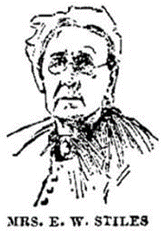
There are differing accounts about the length of Elizabeth’s spying career. Some stories about her say that she served from 1862 to the end of the Civil War in 1865, and President Abraham Lincoln signed her honorable discharge as an army nurse. Others say that she and Clara retired in November 1864. A letter from the Office of the Provost Marshal in St, Louis, Missouri, suggested that they be relieved from duty “they having become known to the rebel sympathizers of the city as Government employees.”
When the Civil War ended for her and Clara, Elizabeth Stiles left Washington D.C. and relocated in Geneva, Ohio. She did not like Geneva, and in 1865, she moved to Niles in Venango County, Pennsylvania. According to the 1870 and 1880 United States Federal Census, she lived with her daughter Sarah and son George in Venango County. Her daughter Clara had married William Seaman on May 30, 1869, at age 17.
Elizabeth Enters the Women’s Relief Corps Home in Madison, Ohio
On October 21, 1895, Elizabeth Stiles, who had been living in Venango, Pennsylvania, was admitted to the Madison Woman’s Relief Corps Home, a few miles from her birthplace.
The National Women’s Relief Corps had established the home in 1891 for needy wives and widows of Union soldiers and for military nurses. In her Cleveland Plain Dealer Magazine article, Grace Goulder recounted that during her visit to the home, then Superintendent Delbert E. Nixon and his wife found Elizabeth’s entry record in the oldest ledgers. For her part, Elizabeth had been delighted to discover that one of the women she met there was the sister of Lt. Hoyt who had escorted her from Shawnee to Fort Leavenworth.
Several newspapers printed stories about Elizabeth’s life and death in the Madison Women’s Relief Corps home. The Cincinnati Enquirer said that her fourscore years had not at all dimmed her mind and her recollections of names and dates were something remarkable.”
The Wellington, Ohio Enterprise from March 10, 1898, noted that Elizabeth had never been wounded during her Civil War service and could never be convinced to ask for a pension until a few weeks ago when she applied to the government for“redress for the amount of her labors when she was obliged to sacrifice everything she possessed in Shawnee Town.
In 1898 at age 82, Elizabeth’s doctors gave her no hope of recovery from a severe surgical operation, yet her family and friends felt that her stamina and determination and wonderful powers of endurance would carry her through the operation and recovery as successfully as they had served her through her Civil War service.
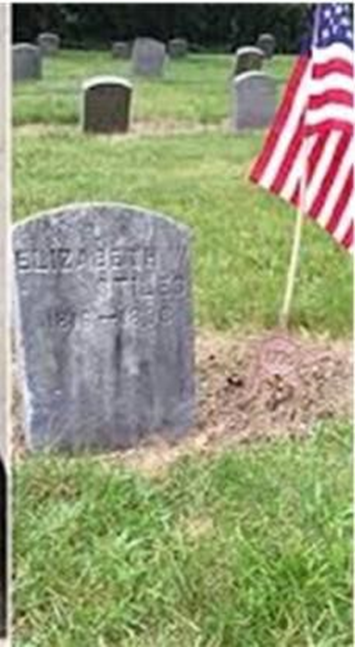
Although her mind remained sharp and alert, Elizabeth’s body succumbed to the effects of time and illness and three years after she entered the home, she died there on July 18, 1898. As a member of the Episcopal Church, she requested that her funeral services consist of a service of song and the reading of the burial service of the Episcopal burial service. She is buried in Middle Ridge Cemetery on Middle Ridge Road in Madison.
 Onward Octagon Ohio History: Cupola Chronicles